
The 7 Items I Stage in Every Single Maine Home
After staging homes in Southern Maine, I've noticed something: there are 7 items I reach for again and again. They're not flashy. They're not expensive. They aren't trending on Pinterest this month. But every single one earns its spot in every single home I touch.
Here's what I've learned after walking through more empty kitchens, half packed living rooms, and freshly painted bedrooms than I can count: staging isn't about filling a room. It's not about decorating to your taste, or even strictly to your buyer's taste. It's about making someone walk through the front door, take a breath, and think, "I could live here."
That feeling, that quiet little click of recognition, is the whole game. These 7 small details are what I lean on to make it happen, every time.
One quick note before we get into the list. None of this is about hiding flaws or putting lipstick on a fixer upper. Good staging amplifies what's already working in a home. The lemons and the marble trays and the local magazines aren't there to trick anyone. They're there to make the bones of the house look like the best version of themselves. Big difference.
Okay. Let's get into it.

1. Fresh Lemons
Fresh lemons in a bowl on the counter are my single favorite trick, and they're usually the first thing I unpack when I show up to a new staging job.
Here's why they work so well. They're cheap (a bag of lemons is around four dollars at the grocery store), they last about a week, and the second a buyer walks into the kitchen that pop of yellow signals this home is taken care of. Warmth, color, life. The brain reads it before the buyer even knows what they're reacting to. No candle, no faux fruit basket, no bowl of plastic apples comes close to that.
A few rules I follow. I always go with real lemons over faux. The texture and the slight imperfection of a real lemon is what sells the moment. Faux lemons photograph okay but in person they look exactly like what they are. I also pile them generously. Six to eight in a bowl, not three sad little ones rolling around. Abundance reads as care.
The vessel matters too. A white scalloped bowl, a footed pedestal, a wooden dough bowl, even a simple ceramic mixing bowl in the right shade. Anything but a clear glass bowl, which somehow always reads as "I bought these specifically to stage the kitchen." We don't want that energy.
If a home is going to be on the market longer than a week, I swap them out fresh on every showing day. Sounds excessive. But moldy lemons in a staged bowl are the fastest way to undo every other thoughtful choice you made. Worth the effort.

2. A Scalloped Dish
A scalloped dish is one of those small pieces that does about ten times the work you'd expect from it.
Mine usually live in the bathroom or on a kitchen counter, but they show up in the entry, on a nightstand, or on a small console table too. The reason is simple. A scalloped dish instantly elevates whatever you put on it. A bar of soap and a small wooden brush look like a still life when they're sitting on a scalloped dish. A set of keys and a candle look styled instead of just dropped.
The shape itself is doing real work. Most homes are full of straight lines and hard edges. Cabinets, counters, door frames, baseboards, all rectangles. A scalloped edge introduces softness. It rounds out the visual noise. It feels a little bit French and a little bit storybook in the best way.
I source mine from Homegoods (my fave!), estate sales, and local vintage shops in Portland, Maine. White ceramic is my default because it goes everywhere, but I'll occasionally bring in a pale pink or a soft cream when the home calls for it. Layering different sizes (one small, one medium) on a vanity also looks gorgeous if you want to push it a little further.
If you only buy one staging piece this year, this is the one I'd start with. It works in almost every room. Hard to overuse, easy to love.

3. Local Magazines
Local magazines on a coffee table or entry console do something subtle but really important: they tell a story.
Here's the difference. A stack of generic design magazines on a coffee table reads as decoration. Architectural Digest next to Our Maine Life tells the buyer something specific about who could live here. The people in this home have taste. They care about their region. They're plugged in.They love where they live. Buyers don't consciously process all of that, but they feel it. They start picturing themselves flipping through those same pages on a slow Sunday morning. That's exactly the picture I want them to paint.
I always include at least one truly local title. Maine Home + Design, Down East, Our Maine Life, depending on what's available that month. Pair it with one design heavyweight (AD is my go to) and maybe one lifestyle title for visual variety. Three magazines is the magic number. More than that and the moment starts to feel like a doctor's office waiting room.
Placement matters. Slightly fanned, not perfectly stacked. A little casual, like someone actually picks them up. I'll often put a small object on top, a tiny brass animal, a stone coaster, a piece of sea glass, something that adds a hint of personality without being precious about it.
Buyers spend more time in homes that feel like real people live there. Magazines are a fast track to that feeling.

4. Marble Trays
Marble trays are my secret weapon for taming the small stuff.
A soap dispenser sitting alone on a kitchen counter or bathroom vanity reads as clutter. The exact same soap dispenser on a marble tray with a little ceramic dish next to it reads as intentional. Same items. Completely different feel. I cannot say this enough: containment is its own kind of luxury.
I keep a few sizes on hand at all times. Small ones for kitchen sinks (soap, sponge, hand cream). Medium for bathrooms (soap, lotion, a little plant or a vintage trinket dish). The occasional larger one for entry tables or coffee tables, where they corral candles, a stack of coasters, and a little vase.
Real marble has weight to it, both literally and visually, and that's part of why it works. It signals quality without being loud about it. Faux marble can work in a pinch but the edges almost always give it away. If you're investing in one nice tray, make it real. You'll use it forever, in every home you ever live in.
A small note on color. White marble with gray veining is the most flexible, but if you have a darker kitchen or a moody bathroom, don't be afraid of black marble or a warmer cream. The tray should feel like it belongs in the room, not like it was airdropped in from a styling shoot.
Containment is its own kind of luxury. Worth repeating.
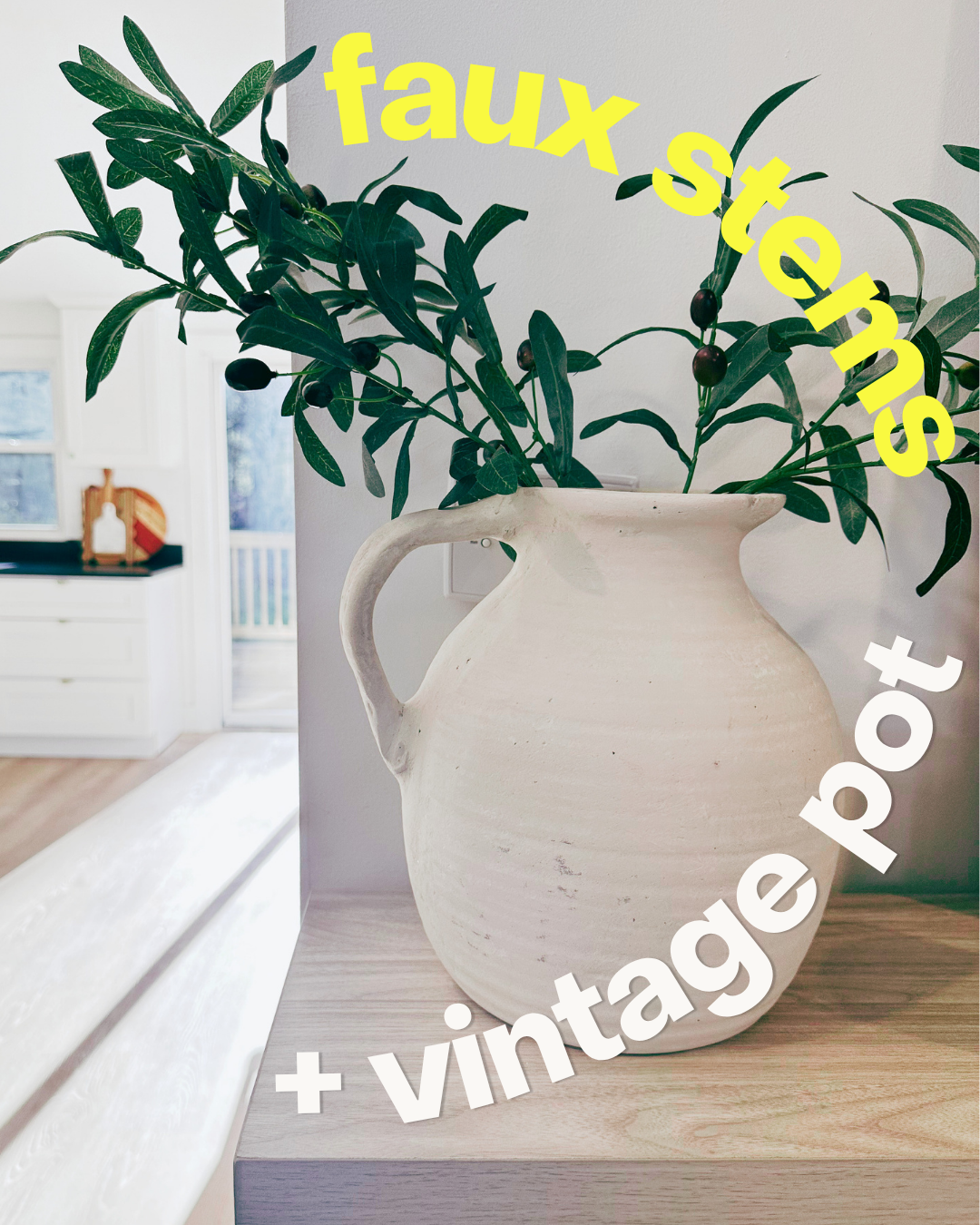
5. Faux Stems and a Vintage Pot
Faux stems in a vintage pot are my answer to "I don't want to babysit fresh flowers every week of a three month listing."
Fresh flowers are beautiful, but they're a real commitment. Faux stems, when chosen carefully, can give you 90 percent of the impact with none of the maintenance. Olive branches are my forever go to. Amazon is my favorite place to grab these inexpensively. Eucalyptus, magnolia leaves, fig branches, and dogwood all work too. What I avoid: anything that's trying too hard to be a flower. No silk roses. No glittery anything. The goal is "I went on a walk and clipped these myself," not "I bought these at the craft store in 2014."
The real trick is the vessel. Something a little imperfect, a little earthy, ideally something that looks like you found it at an estate sale, whether you actually did or not. A creamy ceramic pitcher with a faint chip on the handle. A handmade pottery vase in a soft neutral. A vintage olive oil jar with a patina that took 70 years to earn.
Stay away from anything too polished. Too clean. Too obviously new. The vessel is doing just as much storytelling as the stems are, and you want it to whisper, not shout.
Placement wise, these go almost anywhere. Kitchen counters, dining tables, entryway consoles, bathroom vanities, mantels, primary bedrooms. I'll often have two or three of these scattered through a single home. They unify the rooms without ever feeling matchy.
If you only invest in one vintage pot, make it a midsize one with a generous belly. Most versatile shape.

6. Kitchen Essentials
A simple kitchen vignette is one of the easiest wins in the entire staging playbook.
Here's the formula. I'll set a small marble or wood riser on the counter, near the stove or against the backsplash, and stage a bottle of olive oil, a bottle of balsamic, a nice pepper grinder, and one tiny plant or stem. That's it. Four objects. Maybe five if the counter has the room and the room has the energy.
Empty counters read sterile. They make a kitchen feel like a showroom, which sounds like a good thing but actually makes it feel cold and unused. A curated little corner reads welcoming and lived in. That's the sweet spot we're chasing. The buyer should be able to picture themselves cooking pasta on a Wednesday night, not just admiring the quartz.
A few details that matter. Match the metals (brass and brass, or chrome and chrome, not a mix unless you really know what you're doing). Use real oil and real vinegar in the bottles, not water tinted with food coloring. Yes, people do that. No, it doesn't fool anyone. And keep the labels simple. White minimalist labels, or no labels at all, photograph and stage best.
The riser itself is the unsung hero of this whole arrangement. It adds height, anchors the vignette, and turns four random objects into a composition. Don't skip it. A flat lineup on the counter looks like the previous owner forgot to put their groceries away. The riser turns it into something intentional.

7. A Viewfinder
And then there's the telescope. I know. This one's a little unexpected, but hear me out.
Whenever a home has a great view (water, woods, mountains, open sky, even a beautiful tree line) I'll set up a telescope or binoculars by a window. Not in every room. Just one focal spot, usually a sitting area, a sunroom, or a primary bedroom corner. The effect is immediate, and it does something almost no other staging move can do. It tells the buyer this view is worth pausing for.
Most homes with great views actually under sell those views. The furniture faces the TV instead of the window. The curtains are heavy. The view becomes a thing you'd notice on day one and then forget by week two. A telescope changes the math entirely. It signals that this home offers a particular kind of life, the kind where you stop, look, and notice the world outside the window.
I keep a midsize telescope in my staging inventory specifically for this reason. It doesn't have to be high end. It just has to look like it gets used. I'll often add a small stack of nature books or a pair of binoculars on a nearby table to round out the moment.
Is this overkill for some homes? Yes. Skip it for a small in town condo where the only view is the neighbor's porch. But for the lake house, the woodland retreat, the home with the south facing windows that catch the light all afternoon? Every single time.
The Through Line
That's it. Seven items. None of them are precious or hard to source, and most of them rotate between the homes I stage week to week. There's no big secret here, no expensive trick, no perfect formula you have to follow exactly.
What ties them all together is the story they tell. Lemons say this kitchen is alive. A scalloped dish says someone here cares about the small details. Local magazines say this is a real home with real interests. Marble trays say things have a place. Faux stems and a vintage pot say nature is welcome inside. Kitchen essentials say food gets made here. A telescope says the view is worth your time.
Each item is a small piece of evidence that someone loved this house, lived in it well, and is now ready to hand it off to someone new.
That's what good staging actually does. It's not a costume. It's not a deception. It's a quiet way of saying, "This is what life could feel like here." If you do that part well, the buyer doesn't need to be sold. They just need to walk in.
If you're getting ready to list your home in Maine and want it to feel like all of this was effortless, let me know. Happy to walk through what your space already has going for it and what would actually move the needle. Sometimes you need a full staging package. Sometimes you just need a marble tray and a bag of lemons. I'll tell you the truth either way.
Follow us on Instagram, TikTok & Pinterest
Chrystie